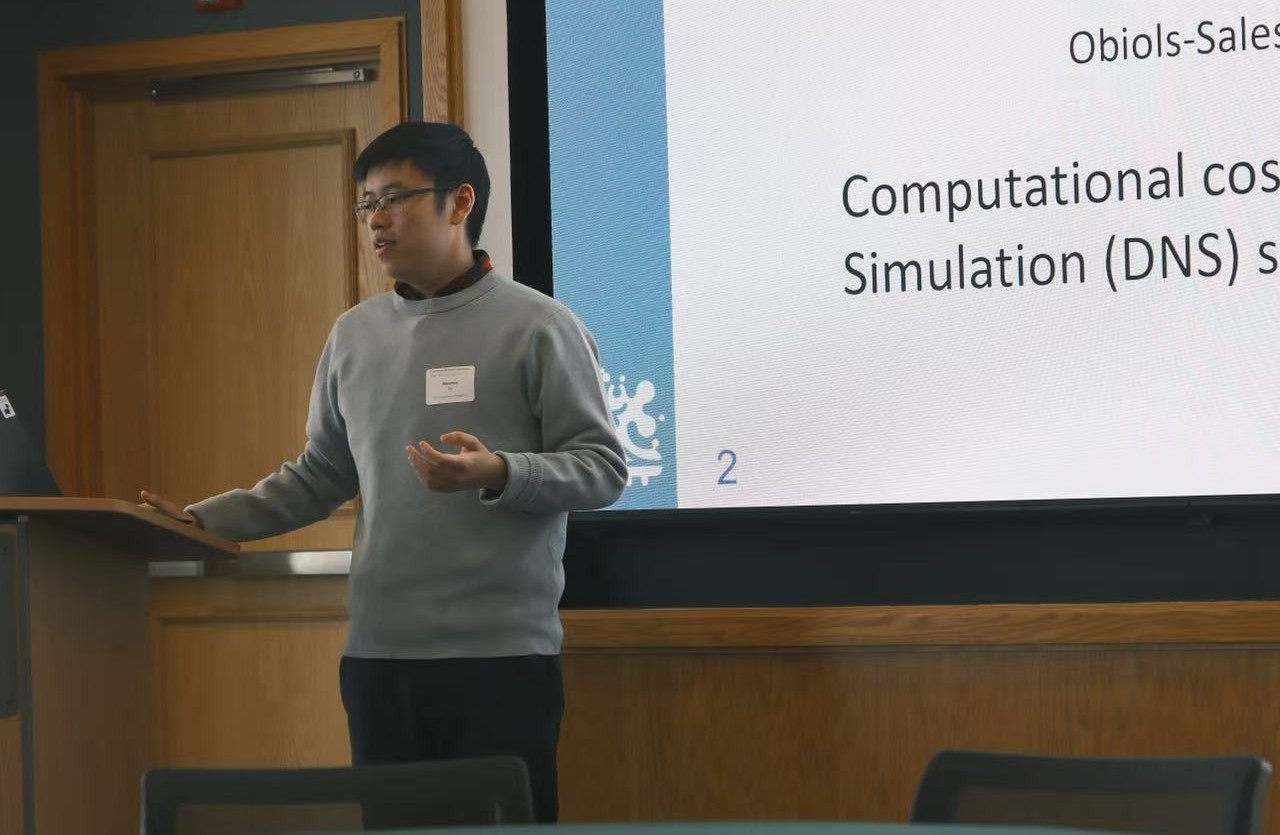
Wenzhuo Xu
I build agentic and vision–language systems that reason about physical processes — how they behave, and whether a generated video or the equations printed in a document actually respect them. I am a Ph.D. candidate in Mechanical Engineering at Carnegie Mellon University (expected May 2027), and I spent summer 2026 as a Research Scientist Intern at Adobe Research. My background is in learned surrogates and neural operators for large-scale fluid simulation, which is where the physics grounding comes from: I spent four years building models that had to agree with a solver, and I now build systems that have to agree with the world.
The thread through both halves is the same — a model’s claim about a physical system should be checkable, and the machinery that checks it should be something a person can read.
Carnegie Mellon University — advised by Christopher McComb and Noelia Grande Gutiérrez, Department of Mechanical Engineering, CMU
Adobe Research — Research Scientist Intern, summer 2026, with Tong Sun and Jiuxiang Gu
Labs — Design Research Collective · BioSiMMlab
Email / CV / Google Scholar / GitHub / LinkedIn
Projects
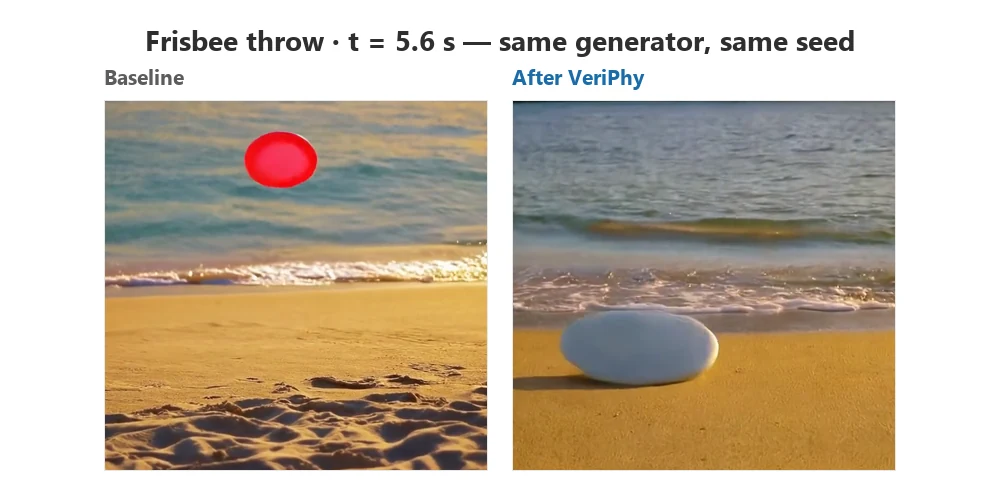 Agentic physical reasoning for world model evaluation
Video generators are scored with one opaque number. This turns the score into an auditable verdict you can trace back to a measurement.
Executable physics from static documents
The physics printed in a textbook is inert. This reads the equations and the prose around them and compiles a simulation you can actually run.
Agentic physical reasoning for world model evaluation
Video generators are scored with one opaque number. This turns the score into an auditable verdict you can trace back to a measurement.
Executable physics from static documents
The physics printed in a textbook is inert. This reads the equations and the prose around them and compiles a simulation you can actually run.
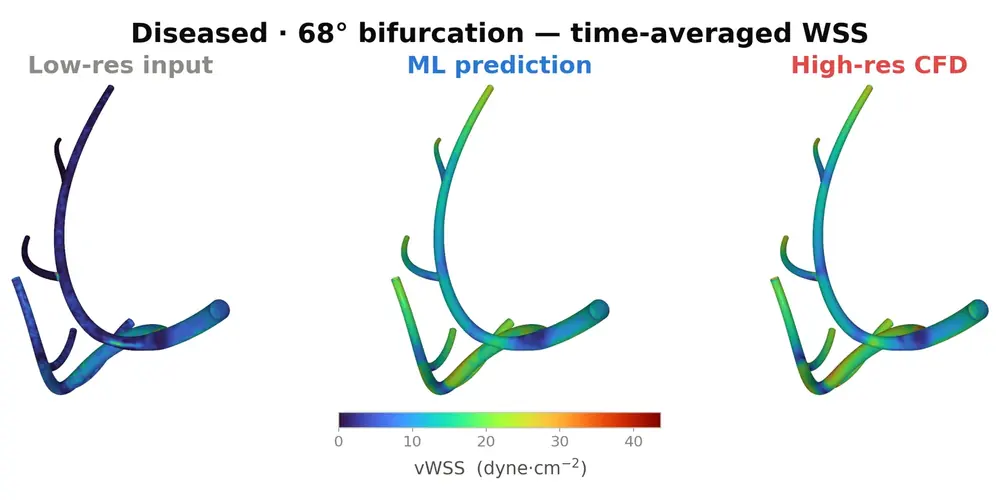 Super-resolution for cardiovascular blood flow
A coarse blood-flow simulation gets wall shear stress wrong — the marker that flags a dangerous plaque. A learned correction recovers it in 20 minutes instead of 12 hours.
35×faster than high-fidelity CFD0.92–0.94wall shear stress correlation vs. the reference solver
Super-resolution for cardiovascular blood flow
A coarse blood-flow simulation gets wall shear stress wrong — the marker that flags a dangerous plaque. A learned correction recovers it in 20 minutes instead of 12 hours.
35×faster than high-fidelity CFD0.92–0.94wall shear stress correlation vs. the reference solver
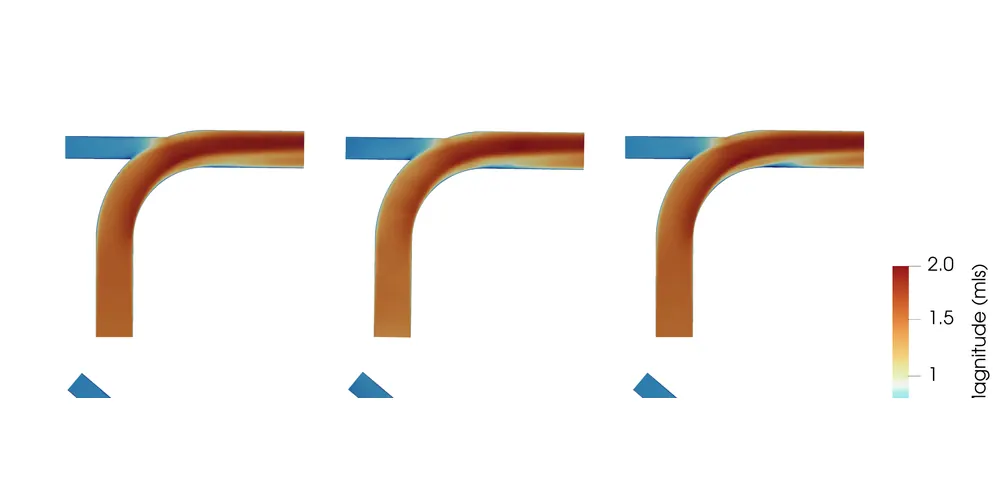 Super-resolution for engineering duct design
High-fidelity CFD answers the next morning, so engineers stop exploring and start confirming. This gets the same answer inside the design loop.
5.5×faster than the high-fidelity simulationDeployedin Eaton's jet engine duct design workflow
Super-resolution for engineering duct design
High-fidelity CFD answers the next morning, so engineers stop exploring and start confirming. This gets the same answer inside the design loop.
5.5×faster than the high-fidelity simulationDeployedin Eaton's jet engine duct design workflow
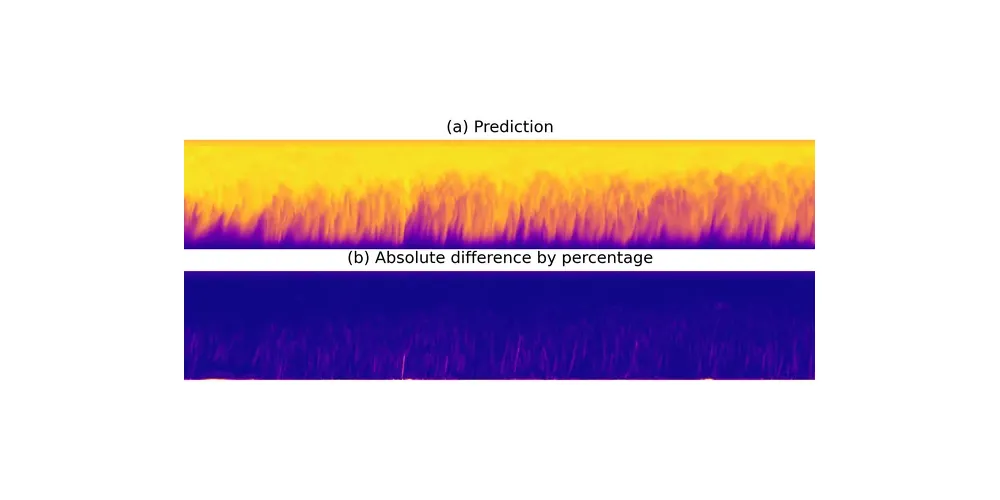 Adaptive local domain decomposition
One network trained on a whole flow ends up mediocre everywhere in it. Cutting the domain into patches and routing each to a specialist model fixes that.
0.66 → 0.80+R² after 20 rollout steps, undecomposed vs. decomposed3physics regimes routed to their own sub-model
Adaptive local domain decomposition
One network trained on a whole flow ends up mediocre everywhere in it. Cutting the domain into patches and routing each to a specialist model fixes that.
0.66 → 0.80+R² after 20 rollout steps, undecomposed vs. decomposed3physics regimes routed to their own sub-model
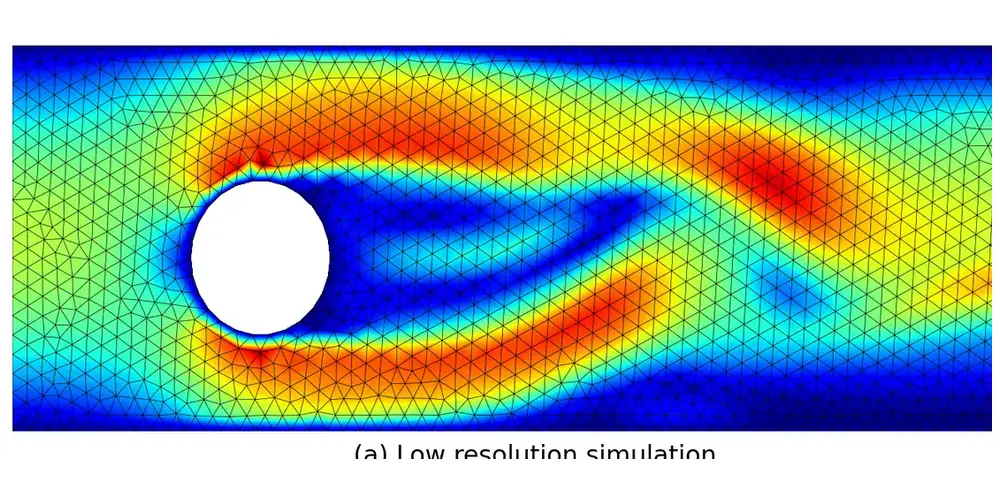 TEECNet and MegaFlow2D
Instead of learning the expensive simulation's answer, learn how wrong the cheap one is — then subtract.
30train/test resolution pairs, one architecture3.2×faster than the neural-operator baseline on 12 cores
TEECNet and MegaFlow2D
Instead of learning the expensive simulation's answer, learn how wrong the cheap one is — then subtract.
30train/test resolution pairs, one architecture3.2×faster than the neural-operator baseline on 12 cores
Recent publications
- VeriPhy: Agentic Physical Reasoning for World Model Evaluation and Refinement arXiv preprint arXiv:2609.03153 (2026)
- Thinking with Anchors: Grounded and Efficient Document Reasoning arXiv preprint arXiv:2608.04424 (2026)
- Scalable super-resolution of flow conveyance systems through adaptive domain decomposition Journal of Computing and Information Science in Engineering 26 (2026)
- Energy-based feature extraction with adaptive local domain decomposition for prediction of transient and turbulence flow with operator regression models Computers & Fluids 307, 106958 (2026)
- Fast super-resolution analysis of low-pressure duct air flow through adaptive domain decomposition ASME IDETC-CIE, Vol. 2A: 45th Computers and Information in Engineering Conference (2025)
- Enforcing the principle of locality for physical simulations with neural operators Journal of Computational Physics 538, 114131 (2025)
Education
- Ph.D., Mechanical Engineering — Carnegie Mellon University, expected May 2027. Advised by Christopher McComb and Noelia Grande Gutiérrez.
- M.S., Mechanical Engineering — Carnegie Mellon University, August 2024. Earned en route to the Ph.D.
- B.Eng., Mechanical Engineering & B.A., German — Shanghai Jiao Tong University, June 2022. Dual-degree program.